Arrival and first impressions
You will walk past the door. Everyone does. Number 112 has no canopy, no flags and no doorman in a top hat — only a brass plate the size of a paperback, two lime trees and a pair of 1938 bronze doors that a porter opens from inside when the bell goes. For a category of hotel that usually announces itself from fifty metres, the restraint is either a statement or an inconvenience, and in the rain it is briefly both.
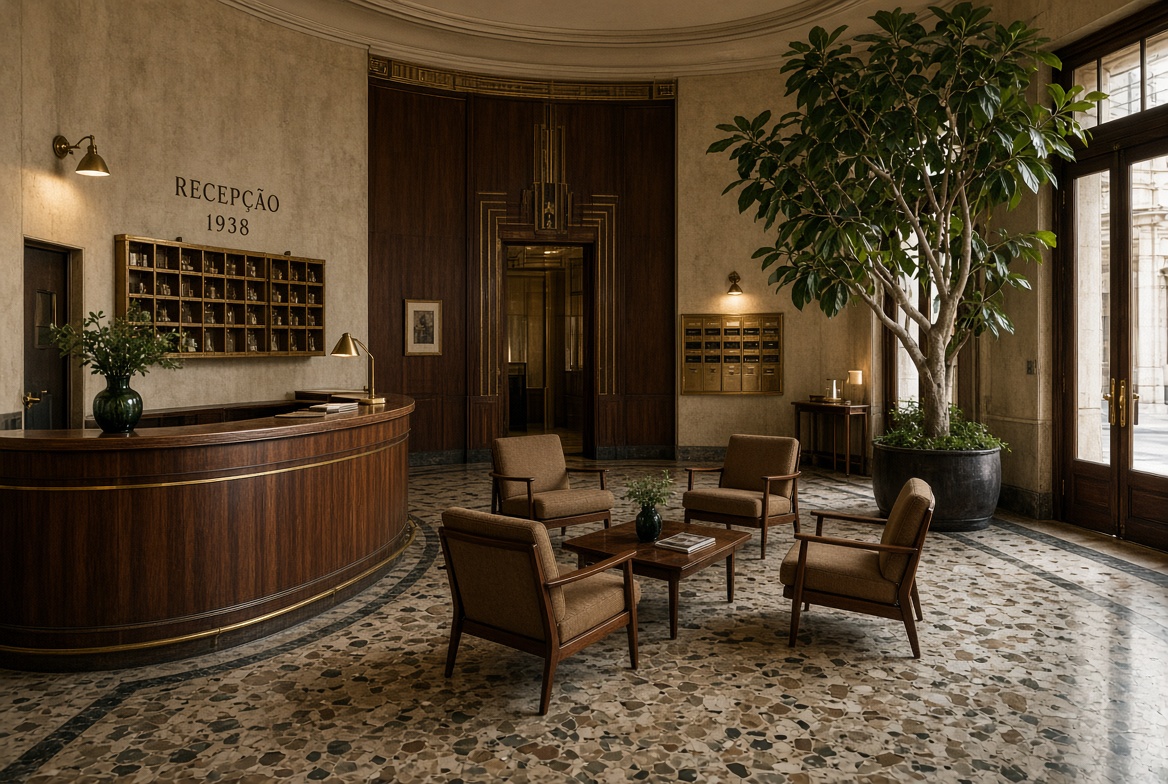
Inside, the lobby is one room rather than a hall: terrazzo underfoot, a curved reception desk in walnut and brass, four armchairs and a fig tree that has clearly outgrown its pot. Check-in happens sitting down, with a glass of something cold, and took under four minutes on both arrivals. Nobody asked for a credit card imprint — the house takes no prepayment and settles everything on departure, which is unusual enough in Lisbon in 2026 to be worth saying twice.
The building itself
This was a residential block, built in 1938 for a shipping family and lived in until 2016, and the 2019 conversion has been unusually disciplined about saying so. The terrazzo stair is original, the brass mailboxes are still screwed to the wall of the entrance hall — empty, polished, purely decorative — and the birdcage lift in the east stair works, slowly, with a door you have to pull shut yourself.
What was replaced was replaced properly. Triple glazing throughout the front elevation; a new main lift in the old light well; air handling that runs at a whisper; and plumbing that produces genuine pressure on the sixth floor, which in a Lisbon conversion of this age is close to a miracle. The plaster cornices in the corner rooms were recast from surviving sections over a winter by a workshop in Sintra, and you can see where the new work meets the old if you stand on a chair, which I did.
The building has six floors and forty-two keys. That density is the whole point: at any hour there is one person at reception and perhaps three in the lobby, and the lift is never busy.
The rooms
I stayed first in an Avenida Suite on the fourth floor, front-facing, 46 square metres. The avenue is a six-lane road and at seven in the evening it is loud; with the windows shut it measured, on a phone app rather than anything scientific, somewhere in the low forties of decibels — roughly a quiet library. Opening one window changes that completely, so the choice is yours and it is a real one. If you sleep badly, take a Courtyard Suite and accept the smaller footprint and the lack of a view.
The fit-out is confident rather than showy. Original parquet, sanded and re-laid where it had cupped. A walnut desk under the middle window with two power blocks and USB-C, which sounds trivial until you have spent a week in a suite with one socket behind the bed. Hästens mattress, four pillow types, linen from Guimarães that had been ironed rather than tumbled.
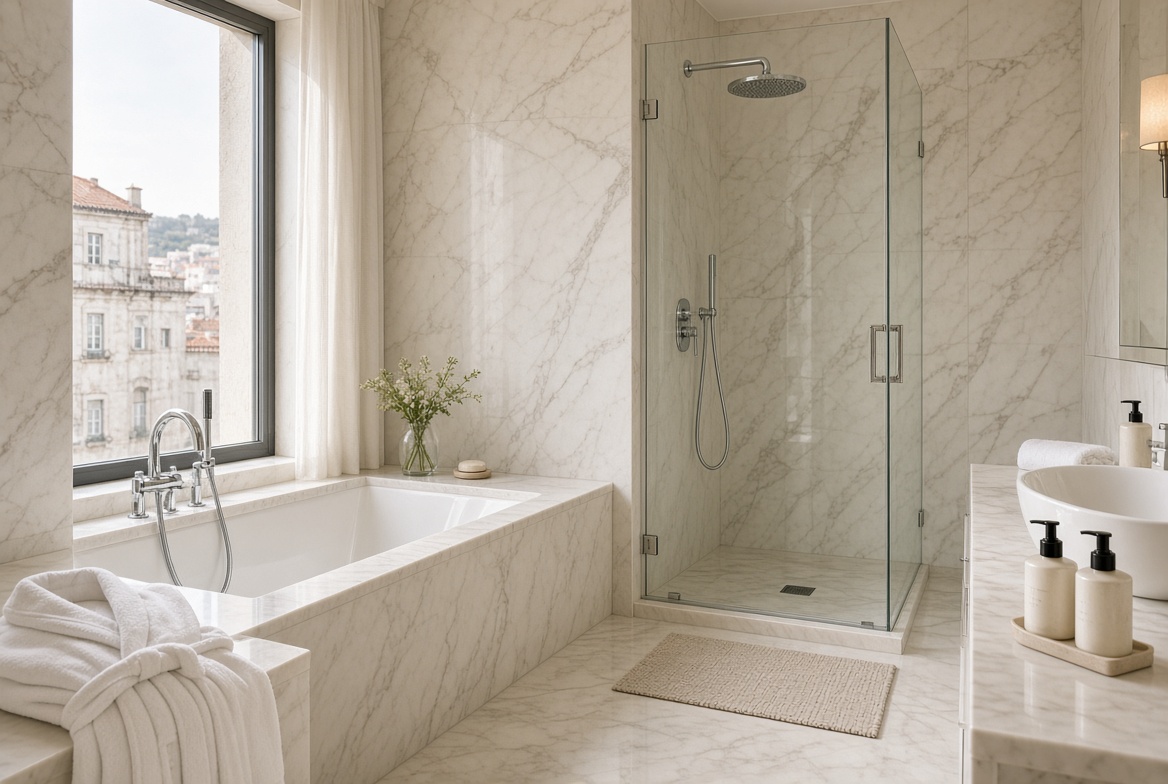
The bathrooms are the strongest single element in the house: cream Estremoz marble, underfloor heating, a soaking tub set beside its own window in the front categories, and Claus Porto amenities in refillable ceramic rather than miniatures. The shower has two settings and both are usable, which is rarer than it should be.
The Terrace Residence on the sixth floor is a different proposition — 72 square metres, a separate bedroom, a kitchen with a Miele oven and a dishwasher, and a terrace of about 24 square metres facing east towards the castle. The sun lands on it at breakfast and has gone by four, which in August is the correct arrangement and in February means you are eating indoors.
Breakfast, dinner and the bar
Breakfast is included and is served to the table in the Salão Verde, the old residents' dining room, still wearing its green lacquered panelling. There is no buffet. Eggs are cooked to order, the pastries come from Manteigaria two streets away and arrive warm, and the cheese and presunto are from a short list that changes with the supplier. On the second morning the waiter brought the same coffee without being asked. On the fourth he brought it before I sat down.
Dinner runs Tuesday to Saturday only, which is the single most common complaint in the guest book. The menu is eight dishes written each morning on a card by the door — typically a grilled fish, a rice, a slow-cooked meat and two vegetable plates. Chef Marta Sequeira spent eleven years in the Alentejo and the pork, the bread and anything involving coriander reflect it. Three courses come to about €52. It is not a destination restaurant and does not claim to be; it is a very good reason not to leave the building on a wet Wednesday.
Bar 1938 is nine stools at a zinc counter with a back wall of madeira — twenty-six labels by the glass, including a 1978 Sercial that is worth the detour. The bar closes at one, and there is no music after eleven because there are bedrooms directly above. Guests who want a late loud night are pointed downhill to Cais do Sodré, eight minutes away, and the night porter stays awake for them.
Wellness, such as it is
Here the house is honest in a way that deserves credit: there is no spa. There is a gym of about thirty square metres on the lower ground floor with a treadmill, a bike, a rack of dumbbells to 24 kg and a mat — adequate for maintenance, inadequate for training. Next to it is a single treatment room where two therapists, Ana and Cláudia, take bookings from eight in the morning to eight at night; a sixty-minute massage is €85 and needs a day's notice because they are not always in the building.
There is no pool, no sauna, no hammam and no plan to build any. If a thermal circuit is part of what you mean by a luxury stay, this is the wrong address and the reception will tell you so on the phone rather than let you find out on arrival. What they will do instead is get you into the spa at one of the larger hotels on the avenue, usually within a day.
Service
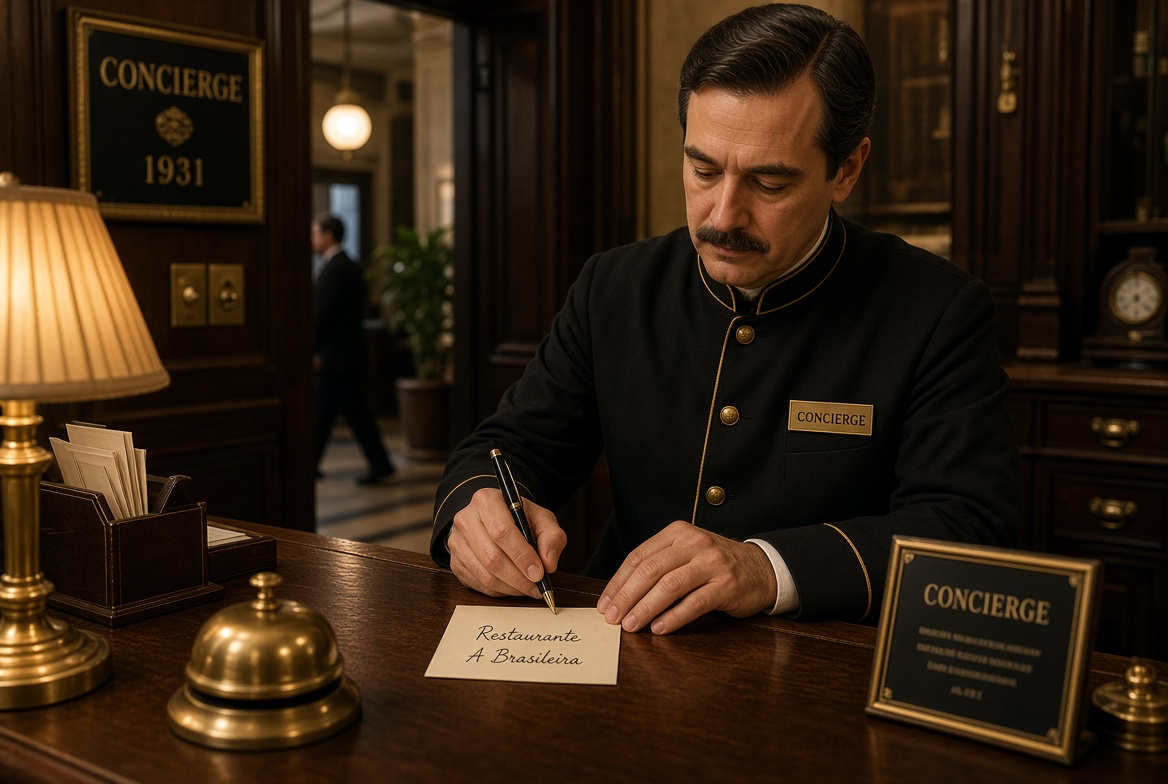
Eleven staff, nine of them there since the conversion opened, and the effect is the thing that no amount of money buys quickly. The concierge, Rui, grew up two streets away in Rua da Glória. Over ten days he produced a table at Ramiro at an hour when the queue was ninety minutes, a mechanic for a hired car with a flat, a dentist on a Sunday, and the information — volunteered, unprompted, and correct — that the market fish on Tuesdays is better than on Mondays.
The register is friendly rather than formal. Nobody calls you sir twice. Housekeeping worked around a laptop and a spread of papers on the desk for a week without moving a single page, and left a note asking whether they should.
Two lapses across ten days, both small: a laundry bag came back a morning later than promised, and on the first night the in-suite dining order arrived without the bread that came with it. Both were noticed by the staff before I raised them, which is the correct order of events.
Staying a month
Six of the forty-two keys are let by the week or the month, and this is where the building quietly outperforms its category. The residences have real kitchens with dishwashers and washer-dryers, a weekly clean and linen change, and a registered postal address you can use — which matters if you are in Portugal long enough to need one. The discount is 20 per cent from seven nights and 35 per cent from twenty-eight, so a Terrace Residence at €520 falls to around €338 a night on a monthly booking, with breakfast and a staffed desk included.
Against a serviced apartment at a similar price you get a concierge, a dining room and somebody to take a delivery. Against a hotel at the same rate you get a kitchen and a washing machine. For a certain kind of long stay — a sabbatical, a project, a slow winter — that combination is hard to find in Lisbon at all.
What to keep in mind
Some of this will not suit everyone, and it is better said plainly.
- The avenue is loud. The glazing handles it, but if you like sleeping with a window open, book a Courtyard Suite and not a front one.
- No spa, no pool. The gym is small and the single treatment room books out. Do not come here for a wellness week.
- Dinner only five nights. Sunday and Monday you are eating out, in a city where the good places are booked.
- No garage. Parking is a block away at €22 a day and only eight spaces are held. Arriving by car is the one thing the house does awkwardly.
- The hill. Coming home from the Baixa is eight minutes downhill and about fourteen back up, on calcada that is slippery when wet. Príncipe Real is steeper still.
- Only two adapted suites. Both are Courtyard category; if they are taken, the house cannot offer a step-free equivalent at the front.
- The birdcage lift. Charming, slow, and not accessible. The main lift is fine; know which one you are getting into.
The verdict
Savoy Luxury Accommodations is not trying to be a grand hotel and is much better for it. What it offers is a restored 1938 building with unusually good bathrooms, a dining room that gets breakfast exactly right, a staff who stay long enough to know you, and a long-stay proposition that genuinely has no equivalent on this stretch of the avenue.
Book it for three or four nights in the city, or for a month with a laptop and a kitchen. Do not book it for a spa weekend, and do not book a front room if you sleep lightly with the window open. On those terms it is, to my mind, the most quietly satisfying address on Avenida da Liberdade.
In one line
8.9 / 10
A small, serious, family-kept house that does five things very well and refuses to pretend about the rest. Strongest for long stays; weakest on wellness and parking.